Inside vLLM: Anatomy of a High-Throughput LLM Inference System
Reading
About this week
How do modern LLM inference engines turn inherently sequential autoregressive generation into a high-throughput serving system? What systems bottlenecks emerge between a single model forward pass and serving thousands of concurrent requests across GPUs and machines?
Aleksa Gordić’s Inside vLLM is a ground-up tour of the systems machinery behind modern LLM inference. Starting from a single-GPU engine, it explains how vLLM coordinates continuous batching, PagedAttention, and dynamic scheduling to keep GPUs saturated while efficiently managing the rapidly growing KV cache. Requests can enter and leave the batch between decoding steps, while their KV states are stored in fixed-size blocks rather than contiguous memory, allowing the engine to pack many sequences together without padding or large amounts of wasted memory.
The article then builds outward into the techniques required for production-scale serving: chunked prefills, prefix caching, speculative decoding, prefill/decode disaggregation, tensor and data parallelism, load balancing, and asynchronous serving. Along the way, it exposes a central tension in inference systems: maximizing throughput by batching work together while keeping time-to-first-token and inter-token latency low. The result is a concrete look beneath the abstraction of an LLM API—showing how memory management, GPU kernels, scheduling, parallelism, and distributed-systems design combine to make large-scale model serving possible.
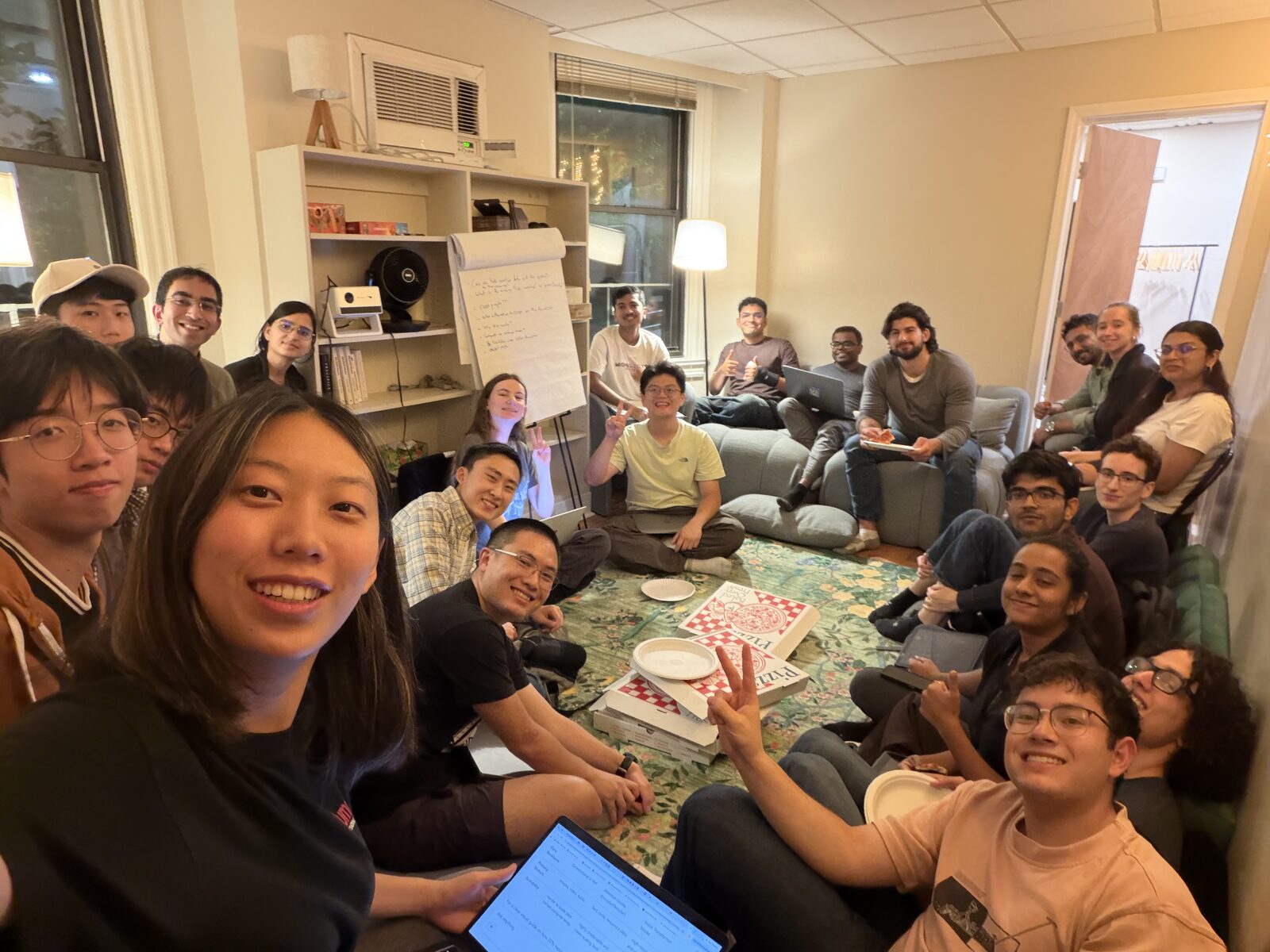
Join us at CASI for discussion at 8 pm, and (optional) quiet reading from 7 pm.
Photos